Report March 2026 - Longchenpa’s Lujong
This month we published two new texts in English and two in French.
Our major publication for this month is the Physical Exercises from Vajra Essence: A Commentary on the Profound Meaning of the Wish-Fulfilling Treasury, by Longchen Rabjam, illustrated by Akyong Tokden, and annotated by Lama Jigme Namgyal. This illustrated guide presents the twenty physical exercises (lüjong) that are extracted from the section on the physical preliminaries in Longchen Rabjam's Vajra Essence, a commentary on the same author's Wish-Fulfilling Treasury. As Longchenpa explains, these exercises "stimulate the vital points of the elements and prāṇas, causing wisdom to arise where it has not yet arisen, and to increase wherever it has arisen." Each exercise targets specific ailments of the body—from the limbs and joints to the internal organs and sinews—forming a complete sequence that culminates in the so-called bha shake. Given their clear resemblance, it is almost certain that these exercises provided the basis, or perhaps tendrel, for Jigme Lingpa’s own treasure revelations of yantras (trulkhor).
The instructions are annotated by Lama Jigme Namgyal, and the accompanying illustrations were likely drawn by Akyong Tokden Lodrö Gyatso (1928/1930–2002) from Dzogchen Monastery in Tibet. The notations and illustrations serve merely as a reminder for those who have learned these exercises from a qualified lineage holder.
There is no mention here of the need for any empowerment, nor are there are complicated visualizations, prāṇāyāma, or major yogic falls (beb). In consultation with the lineage holders, therefore, these exercises have been deemed suitable for a more general audience. Nevertheless, as with any form of yoga, it is still necessary to learn this technique from a qualified lineage holder.
Our second text is A Brief Note on Elaborate Water Torma Offerings, by Jigme Lingpa. In this brief note, Jigme Lingpa clarifies the meaning of "repayment" ('khor ba) in the context of karmic debts, and identifies the scriptural sources for the water torma practices within the Kangyur, while pointing out that disputes among divergent Tibetan traditions of offering tormas lack a canonical basis.
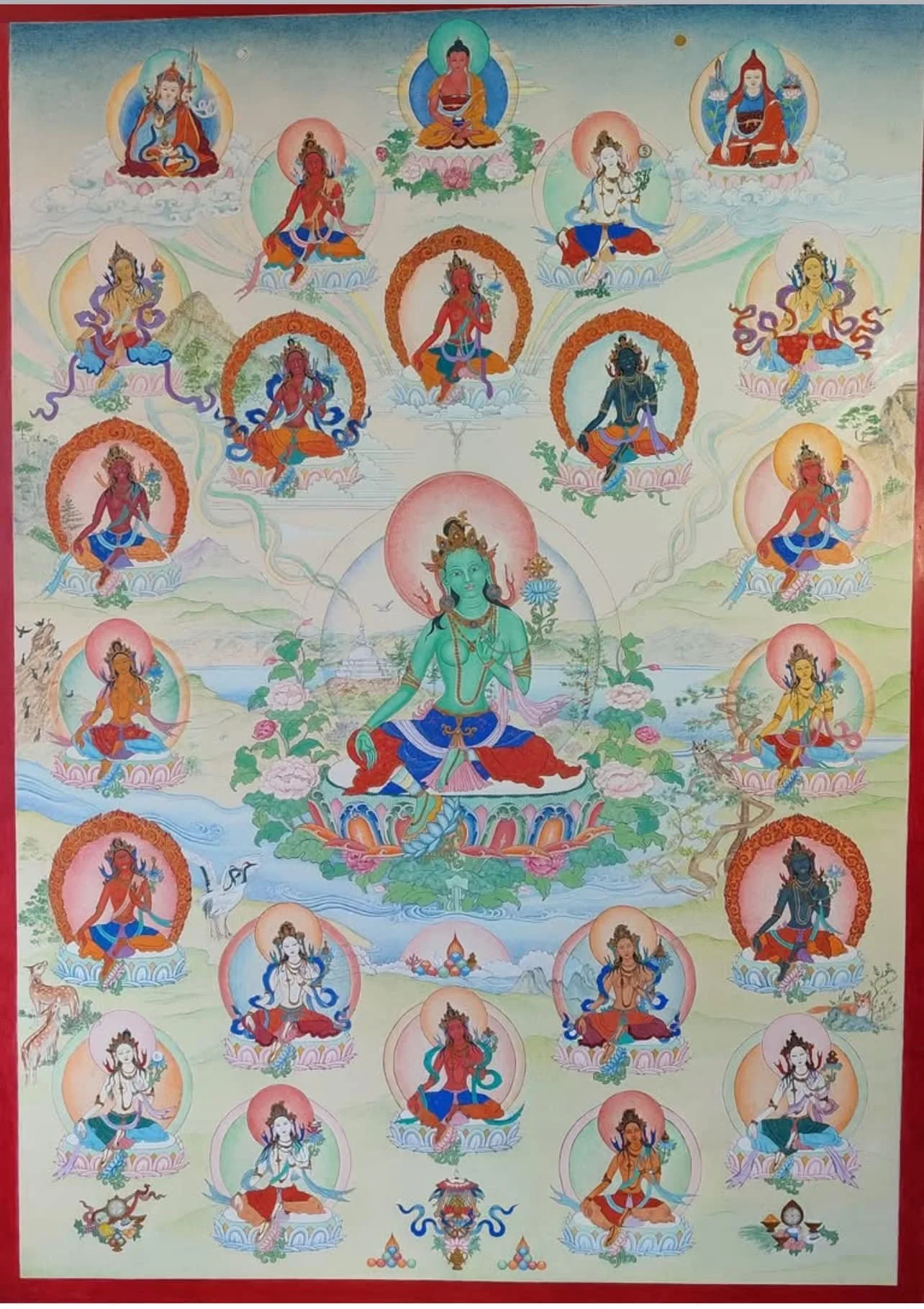
21 Taras according to the Longchen Nyingtik commissioned by Irina Machitski and painted by Angeli Lhadripa Shkonda.
Furthermore, we keep adding artwork to our Thanka Page. Recently we added a beautiful modern thanka of the 21 taras according to the Longchen Nyingtik. A high resolution scan can be found on our webpage. Much gratitude to Irina, who commissioned the thanka and made the file available to us.
For the anniversary of Jamyang Khyentse Wangpo, we wrote a short blog presenting a summary of his works related to the Longchen Nyingtik. Jamyang Khyentse Wangpo (1820–1892) was one of the most extraordinary figures in the history of Tibetan Buddhism—a master whose breadth of learning and realization spanned virtually every lineage and tradition. Recognized as the body incarnation of Jigme Lingpa, he was one of the principal founders of the Rimé movement and held an unrivalled treasury of teachings, having received and mastered transmissions from over 150 teachers across all schools.
In French
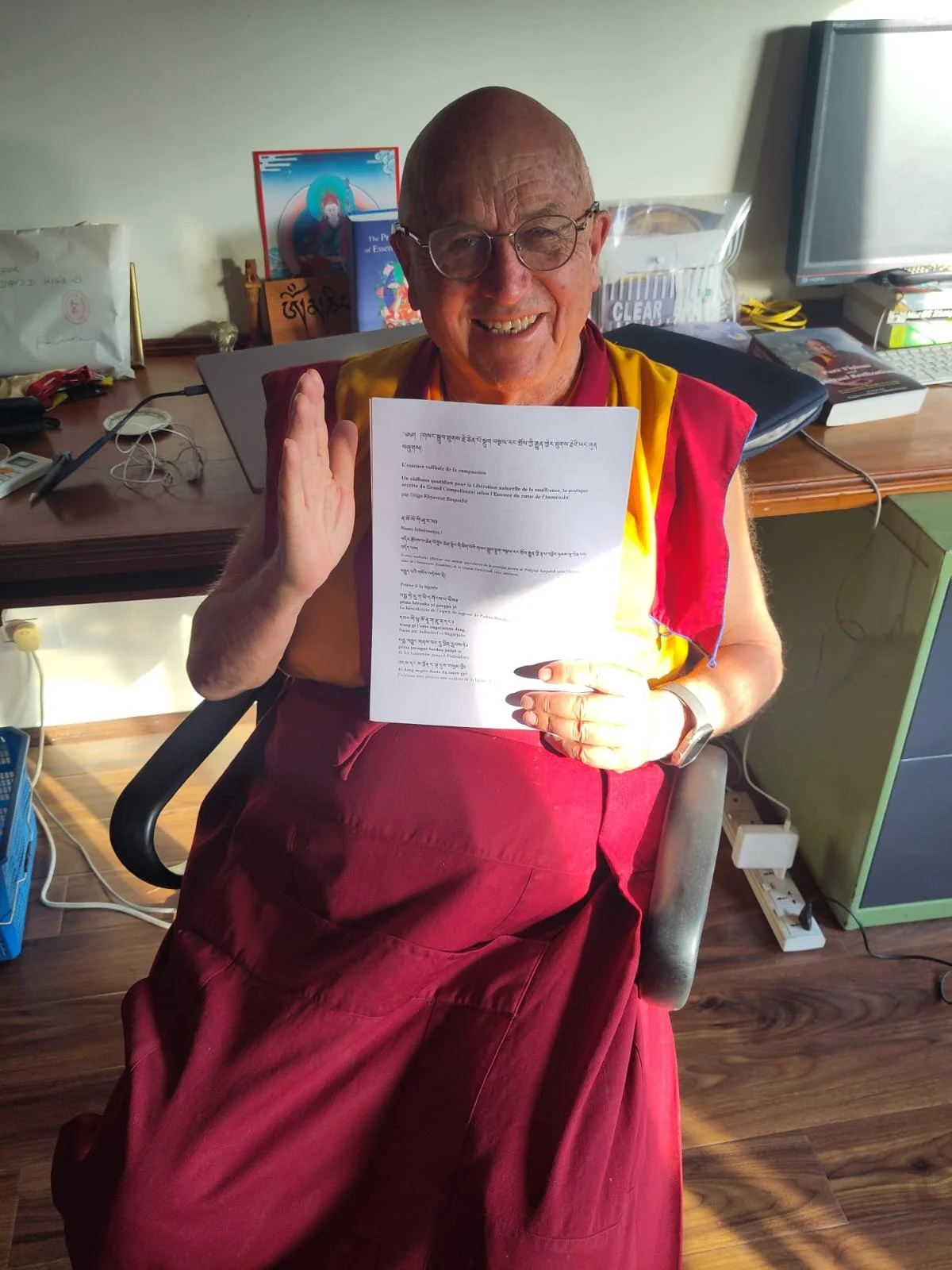
We offered the French translation of the Daily practice of Dukngal Rangdrol, written by Dilgo Khyentse Rinpoche at the request of Yahne Le Toumelin (the mother of Matthieu Ricard), to Matthieu Ricard, who was very happy to receive it and told us his mother knew it by heart.
La vision : Prière à Ārya Avalokiteśvara, par Jigmé Lingpa
En 1758, un an après sa première (et principale) révélation en lien avec Dukngal Rangdrol, Jigmé Lingpa a eu une vision d’Avalokiteśvara, le Grand Compatissant, se tenant debout dans l’immensité du ciel, vers l’est. Dans sa biographie, le grand maître raconte avoir versé des « larmes de dévotion » ; c’est alors qu’il a composé cette prière.
L’essence raffinée de la compassion : Un sādhana quotidien pour la Libération naturelle de la souffrance, la pratique secrète du Grand Compatissant selon l’Essence du cœur de l’immensité, par Dilgo Khyentse Rinpoché
Un sādhana quotidien de Dukngal Rangdrol (sdug bsngal rang grol), ou « Libération naturelle de la souffrance ». Cette pratique d’Avalokiteśvara issue du Longchen nyingtik peut être classée soit comme une pratique de yidam paisible, soit comme la pratique secrète du guru dans la section du cycle consacrée aux vidyādhara masculins et paisibles.