Report July 2026 - White Tara and Path of Method
This month we published 2 new texts in English, 3 in French and 1 in German.
Our first text is The Distinction Between the Path of Method and the Path of Liberation, by Patrul Rinpoche. In this short text, Patrul Rinpoche explains the distinction between the path of method (thabs lam) and the path of liberation (grol lam), showing how they are applied by disciples of differing capacities.
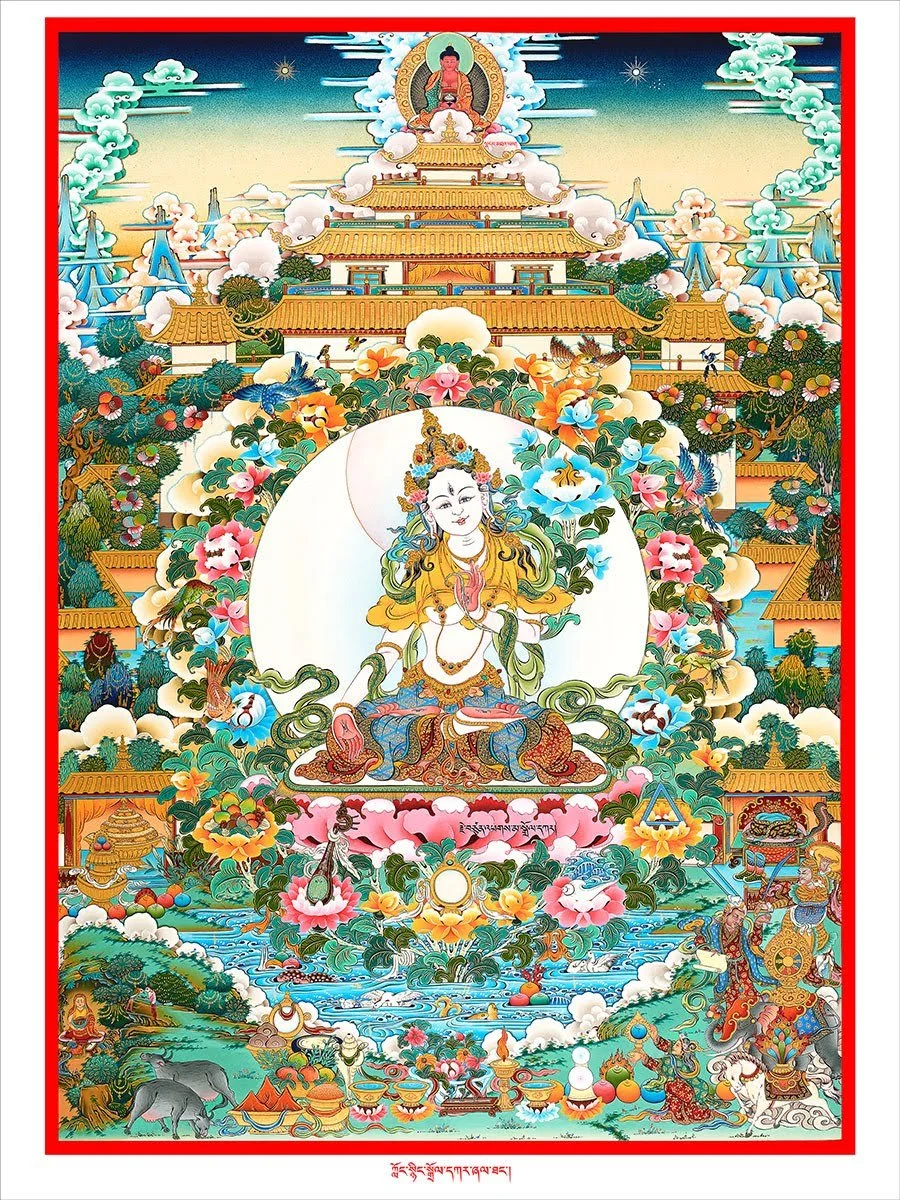
White Tārā "Wish-Fulfilling Wheel". Courtesy of Chorten Dodrupchen Monastery.
Our second text is The Sādhana from The Cycle for Accomplishing the One Maṇḍala of White Tārā from Atiśa's Tradition Together with Various Activities, by Jigme Lingpa. This is the main sādhana of White Tārā "Wish-Fulfilling Wheel" as practised in the Longchen Nyingtik and is the composition of Jigme Lingpa himself. Although not included among his revealed treasures, it is part of the Longchen Nyingtik's core text collection. The practice draws on three lineage streams: the long kama lineage of Atiśa's tradition of White Tārā Wish-Fulfilling Wheel; the close terma lineage of Chöjé Lingpa (1682–1720), who revealed a cycle of Tārā instructions from the Red Tomb in Chonggyé; and, most significantly, the extremely close lineage of Jigme Lingpa's direct visionary blessing from Tārā herself.
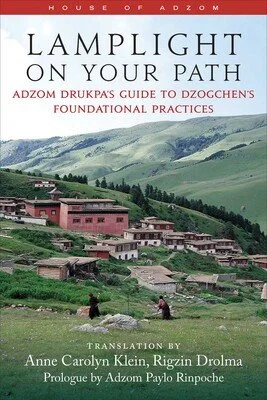
A major new book of the Longchen Nyingtik, Adzom Drupa's Lamplight on Your Path, has been translated by Anne Klein. You can pre-order the book now. Translated here for the first time, Adzom Drukpa’s (1842–1924) Lamplight on Your Path details for readers the unique practices grounding the Dzogchen path to liberation. This path was revealed by Jigme Lingpa (1730–98) as part of his Longchen Nyingthig cycle of teachings and is the basis for both Patrul Rinpoche’s beloved Words of My Perfect Teacher and Adzom Drukpa’s Lamplight. These foundational practices, known as ngondro, offer a way to fundamentally shift one’s heart and mindset, preparing one for the uniquely refined awareness that is both the method and the pinnacle of Dzogchen practice.
Adzom Drukpa received the Longchen Nyingthig foundational practices from Patrul Rinpoche, whom he revered as Vajradhara. Throughout his work, Adzom Drukpa frequently cites, paraphrases, and directs students to Patrul Rinpoche's seminal text, The Words of My Perfect Teacher. In his own commentary, The Lamplight, he builds upon this foundation by sharing his personal insights and experiences with these practices. Simon and Schuster website
This month it was the anniversary of Shechen Gyaltsab Gyurme Pema Namgyal (1872-1926). Notably, this year commemorates the centenary of his passing into parinirvana. He was the root teacher of Dilgo Khyentse Rinpoche and one of the main teachers of Jamyang Khyentse Chökyi Lodrö. Shechen Gyaltsab's main yidam deity was the Vajrakilaya practice of Guru Chowang called Yangsang Pudri. After doing a short retreat he attained complete realization. He wrote a fairly large commentary on it called Words of the Vidyadharas. We are very fortunate that Khenchen Pema Sherab Rinpoche, the senior most Khenchen of the Nyingma tradition, has accepted to teach on this text between 3–12 October in France at Lerab Ling monastery. For more information, please consult their website (more information is yet to be announced). Lerab Ling website
From Dilgo Khyentse Rinpoche's biography:
"In the past, after Vajradhara Khyentse Wangpo had given the complete cycle of Vajrakilaya empowerments from the orally transmitted and revealed treasure teachings, he told Gyaltsap Rinpoche, ‘Since you are an emanation of master Prabhahasti and Langlab Changchub Dorje, when you go to Shechen you must do an intensive Kilaya retreat in your residence until you perfect all the signs, and then do the fire ceremony.’ In accordance with these words, Gyaltsap Rinpoche did retreat in the Barchung residence of the Shechen Hermitage. After one hundred days, although he hadn’t completed the recitation due to illness, he had acquired all the signs and so performed the fire ceremony. It was then that he left his footprint on a rock near his door.” Fearing that people would find out, he threw the stone far away, but Khamgo found the stone and placed it on his shrine. When I heard that story, I was overwhelmed with faith and felt even more confident in Shechen Gyaltsap than usual."
"Gyaltsap Rinpoche’s personal yidam deity was Guru Chowang’s profound Innermost Razor Kilaya treasure, (Yangsang Pudri) for which he gave us the empowerment according to Jamgön Kongtrül’s writings, including the instructions on the view. Then he gave us the instructions on his own Words of the Vidyadharas commentary on Kilaya, with the maturing empowerment. At the end he said that he had received the complete maturation and liberation from the two Jamgöns, and that by means of this personal deity he had attained a few signs of blessing. After that he gave us the empowerment of Khyentse Wangpo’s profound Quintessential Kilaya of the Hearing Lineage treasure (Netik or Nyengyu Phurba), with the explanation of the four daggers."
Traductions françaises
La Quintessence scellée : La pratique la plus secrète du guru, issue de l’Essence du cœur de l’immensité, par Jigmé Lingpa. Dans le cycle du Longchen nyingtik, la pratique la plus secrète du guru est axée sur Longchen Rabjam et considérée comme un préliminaire indispensable à la pratique du Dzogchen. Jigmé Lingpa l’a révélée vers 1761, pendant sa deuxième retraite de trois ans, puis il l’a gardée secrète pendant cinq ans.
Une ondée de bénédictions : Prière à la lignée de la Quintessence scellée, par Jamyang Khyentsé Wangpo. Une supplique à la lignée de la pratique la plus secrète du maître selon le Longchen nyingtik, appelée la Quintessence scellée (Tiklé gyachen, thig le’i rgya can).
Le chant spontané des ḍākinī : Pratique de comblement et de confession auprès des vidyādhara de la lignée de la Lumineuse essence adamantine, par Jamyang Khyentsé Wangpo. L’auteur a composé cette offrande de comblement lors d’une visite à Gangri Thökar, la principale résidence de Longchenpa, l’été de l’an 1838, alors qu’il n’avait que 18 ans.
Neue deutsche Übersetzung
Ein Dohā als Ornament: Eine wahrheitsgetreue Erzählung des Lebens und der Befreiung des Dzogchenpa Rangjung Dorje (རྫོགས་ཆེན་པ་རང་བྱུང་རྡོ་རྗེའི་དོན་གྱི་རྣམ་ཐར་དོ་ཧའི་རྒྱན།) von Jigme Lingpa. Diese äußere Autobiografie in Versform wurde wahrscheinlich 1786 auf Bitte des Thronhalters der Sakya-Linie, Jamgön Wangdü Nyingpo (1763–1809), verfasst.